Ukulele Lessons for Beginners

Ready to strum your first chords in a warm, welcoming setting?

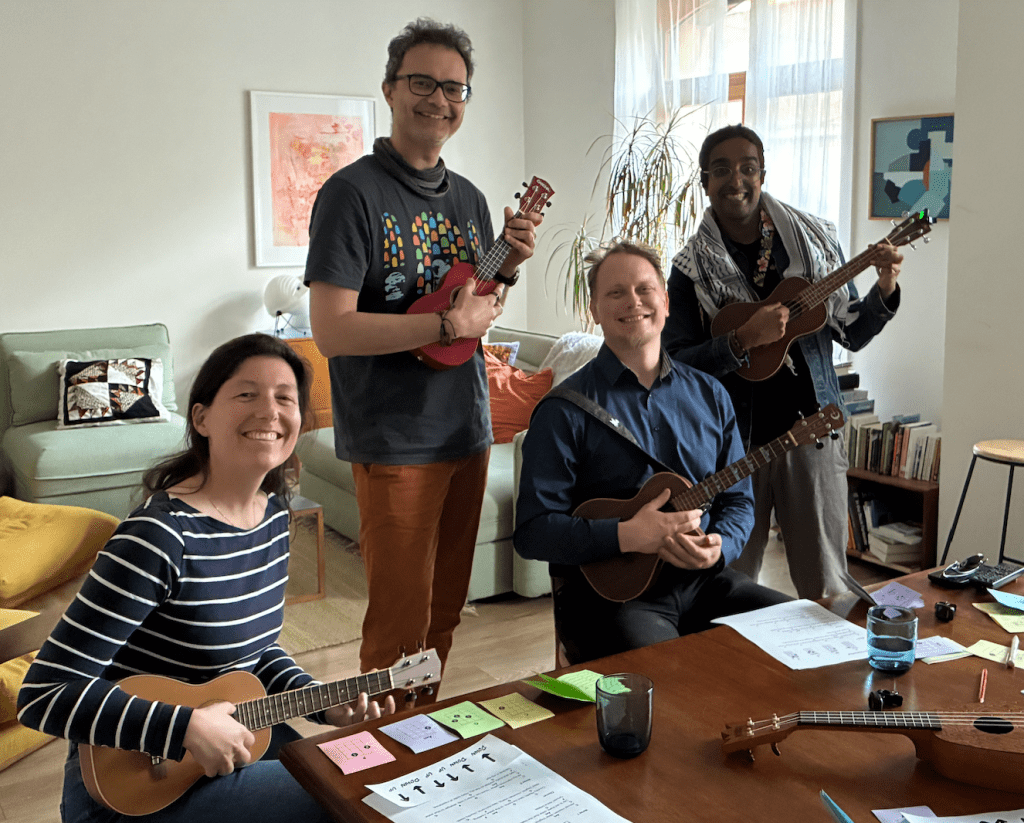
Join our beginner ukulele workshop! I will be hosting the workshop in the comfort of my home in Brussels. With a maximum of 5 participants, you’ll enjoy personalized guidance, joyful learning, and a friendly atmosphere. Whether you’re picking up the ukulele for the first time or revisiting it, this group lesson promises fun, music, and connection.

No experience needed—just bring your curiosity (and a uke if you have one)!

By the end of the class you will be able to:

  • Tune your ukulele
  • Play 4 chords: C, G, F, Am
  • Play a simple strumming pattern
  • Change between chords while staying in rhythm
  • Play a simple song in the group
  • Understand chord charts so you can learn other songs on your own

— AGENDA —

  • 18:00 – Arrive at location. (Location is nearby Brussels Beer Project Port Sud in Anderlecht, Brussels. Exact location will be shared via email 24 hours before the lesson) Drinks and snacks will be made available.
  • 18:30 – Lesson start
  • 20:00 – Lesson end

Dates available

Lessons take place in Anderlecht, Brussels
DATES:
Tuesday 23 September
Tuesday 21 October
Tuesday 18 November

Reserve your seat here

FAQ

I do not own a ukulele. Can you provide me with one for the lesson?
Yes, we can provide you with a ukulele for the lesson. Just let us know before the lesson.

Do I need any prior musical experience?
No you do not. The ukulele is known to be the easiest instrument to learn.

How long is the lesson and where exactly is it held?
The lesson is 90 minutes and will be held at the trainers home (Anderlecht, Brussels).

Is having long nails difficult when playing the ukulele?
Yes, having long nails can make it difficult to play the ukulele, especially on the fretting hand, as they can interfere with proper finger placement and chord formation, potentially leading to buzzes and inaccurate notes. It advisable to keep fingernails as short as possible.

What should I bring to the lesson?
Aside from a ukulele, maybe a notebook, water bottle, and enthusiasm!
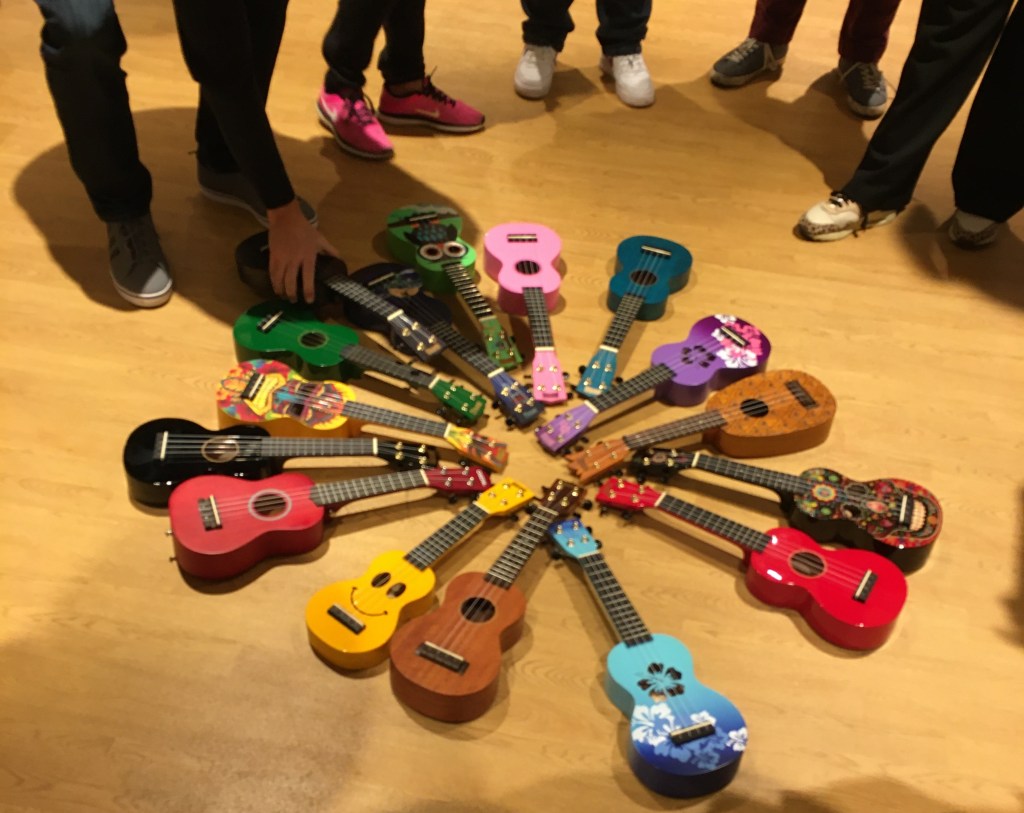
The Power of Play: What a Ukulele Workshop Taught Me About Openness and Connection

Last week at the Imagination Club I had the opportunity to test a workshop titled, “Strumming Curiousity: Embracing Change with the Ukulele”. Fourteen participants took part in ukulele based activities to connect to their inner thoughts as well as connect to others. 

This is what some of them said after the workshop: 

“Making music is fun.”

“It is so natural to be creative.”

“That was so playful and safe.”

Here are my observations and reflections:

1. I was impressed with everyone’s openness and flexibility to just go for it.

It was amazing to witness how willing participants were to embrace the unfamiliar. Everyone approached the ukulele activities with an open mind, ready to experiment and learn. This eagerness to explore without fear of mistakes is a powerful reminder that curiosity thrives in a supportive environment. When we remove the pressure of perfection, we open the door to discovery and growth.

2. Everyone safely entered into the play space (potential space) where everyone explored the unknown together. 

There was a collective sense of trust that made it possible for everyone to step into a space of creativity and spontaneity. This “potential space” is where play, imagination, and connection intersect, allowing people to push beyond their comfort zones in a safe and encouraging way. Seeing the group navigate uncertainty together—whether through tapping the body of the ukulele, plucking a string or two or improvising melodies—reinforced how play can be a powerful tool for collaboration and innovation.

3. Music nourishes our capacity for connection. 

The shared experience of making music created an immediate bond among participants. Music bypasses words and taps into a more instinctive, emotional way of communicating. Whether through synchronized strumming, rhythm, or simply sharing laughter over a missed note, the workshop highlighted how music fosters trust, empathy, and a sense of belonging. This reminds me that in both personal and professional spaces, engaging in creative expression together can deepen connections in ways that traditional team-building exercises often can’t.

I’m looking forward to applying my learnings to improve the next time I run the ukulele team building workshop. 

Thank you Jeffrey & Andy and all the folks who joined in and shared their valuable feedback. 

Contact me if you’re interested to boost trust and connection in your team through the power of music.

Visual Goal Canvas

A chance meeting with Clinical Psychologist, Dr. David Pearson sparked an idea. He explained the approach behind the design of an assessment tool (DLSAS) he had co-authored – 5 questions to help teachers assess students’ core life skills. Impressed with the simple approach, it inspired the design of a learning tool. I was looking for a creative way to introduce my students to some visual thinking concepts. After many iterations, I came up with the Visual Goal Canvas

There are at least 7 components to consider when setting any goal:

What, Why, Who, Where, How, How Much and When.

It’s not sufficient to focus on only one of the components. Mapping all components on a pre-structured canvas offers a quick overview of the entire journey of your goal.

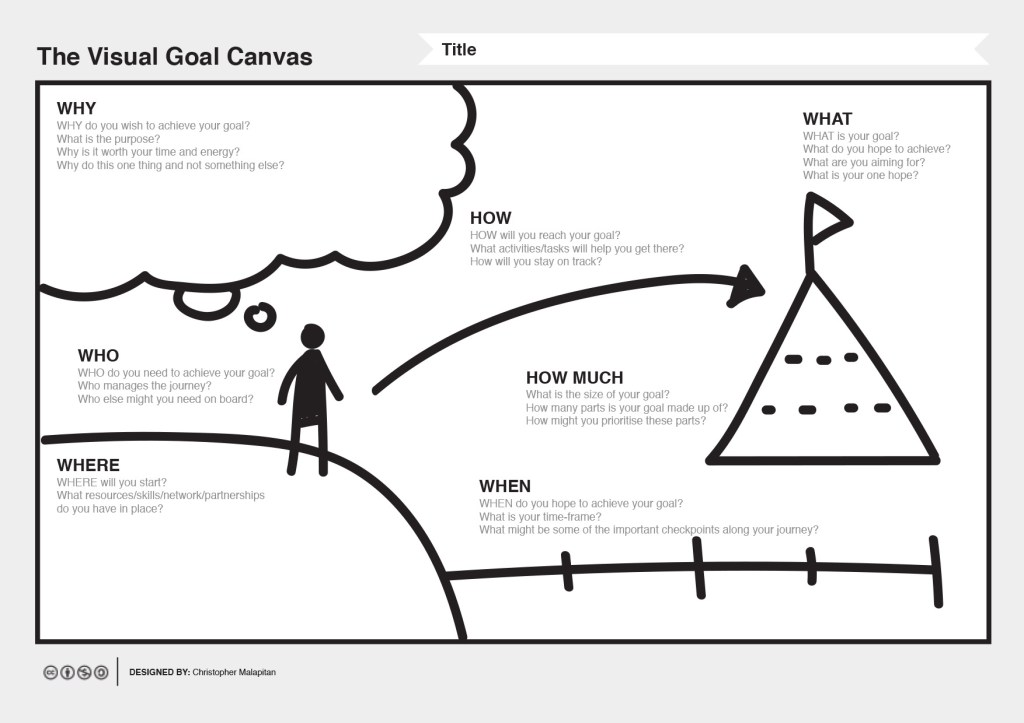
This is the Visual Goal Canvas – a tool to help visually map a goal across 7 components in a single image.

Let’s take a closer look at each of the 7 components: 

  • WHAT is your goal? What do you hope to achieve? What are you aiming for? What is your one hope?
  • WHY do you wish to achieve your goal? What is the purpose? Why is it worth your time and energy? Why do this one thing and not something else?
  • WHO do you need to achieve your goal? Who manages the journey? Who else might you need on board?
  • WHERE will you start? What resources/skills/network/partnerships do you have in place? 
  • HOW will you reach your goal? What are some of the activities/tasks that will help you get there? How will you stay on track?
  • HOW MUCH: What is the size of your goal? How many parts is your goal made up of? How might you prioritise these parts?
  • WHEN do you hope to achieve your goal? What is your time-frame? What might be some of the important checkpoints along your journey?

By exercising visual thinking with storytelling strategies and tools the Visual Goal Canvas can be used to help motivate and guide you or a group towards a goal. 

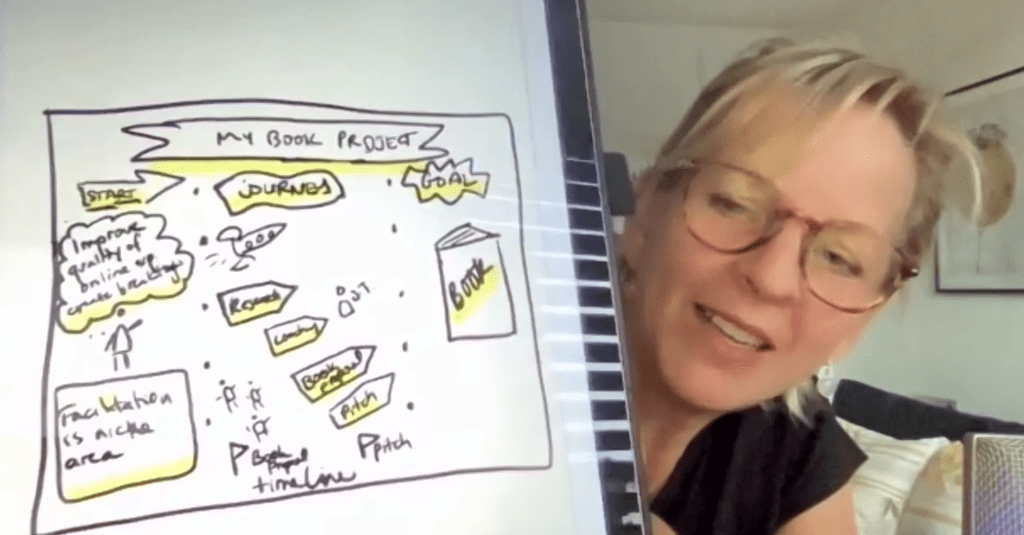
I can easily feel overwhelmed when I try to get new projects off the ground. I get lots of ideas but I can easily lose sight of the big picture. The Visual Goal Canvas helps me organise my ideas and map out the steps to meet my goals. It helped me launch my newsletter. And now I am using it to plan out my next steps for a book!

Gwyn Wansbrough

Breakthrough Facilitation


Some questions to ask when developing your Visual Goal Canvas for personal use or for a group:

  • What challenges might we come across on our journey?
  • What might we need to support our journey?
  • What is missing in our journey?
  • What habits might we need to create/adjust/let go of?
  • How do we make sure we are learning along our journey?
  • How might you celebrate your wins?


Click on the image to download the VISUAL GOAL CANVAS